Bangkok BTS Skytrain Guide: Tickets, Fares, Rabbit Card & Best Routes from Nana
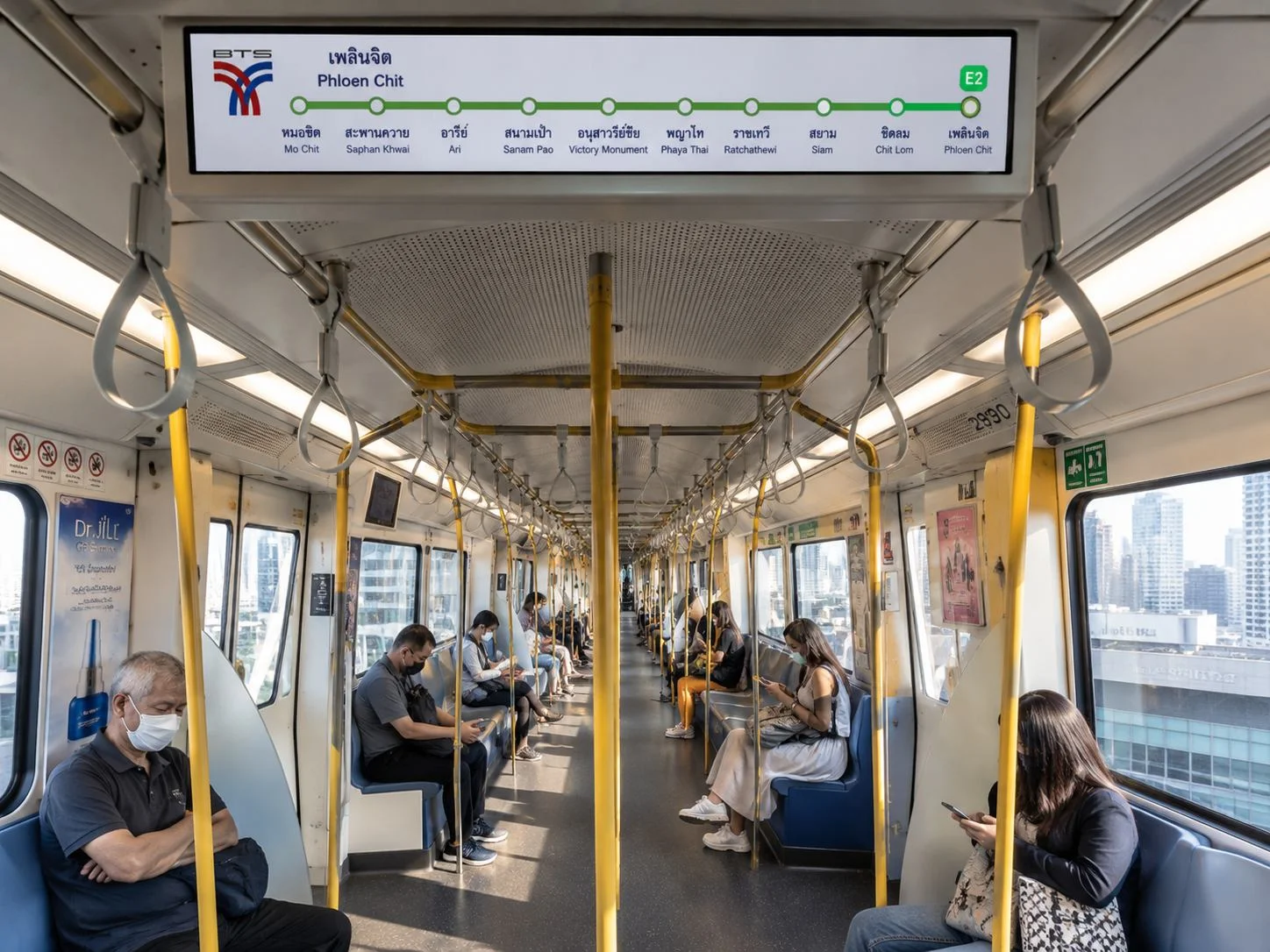
BTS Network Overview: Two Lines Explained
Bangkok's BTS Skytrain opened in December 1999 and remains the fastest, most reliable way to cross the city without hitting traffic. Running entirely on elevated tracks above the gridlocked streets below, the network now covers 68 stations across two colour-coded lines — and continues to expand as new extensions open each year.
Sukhumvit Line (Dark Green)
The Sukhumvit Line forms a wide L-shape through central and eastern Bangkok. It runs south from Mo Chit — adjacent to Chatuchak Park and the Northern Bus Terminal — through the commercial core at Siam, then bends east along Sukhumvit Road through the hotel, dining, and entertainment districts of Nana, Asok, Phrom Phong, and Thong Lo, continuing out to Bearing and the extended Samut Prakan section. Most visitors to Bangkok ride this line every single day.
Silom Line (Light Green)
The Silom Line branches south from Siam station and follows Bangkok's financial and riverside districts. It stops at Sala Daeng (walking distance to Lumpini Park), passes Chong Nonsi in the Sathorn business district, and terminates at Saphan Taksin — the Chao Phraya River pier where express boats depart for Asiatique and the Old City temples. A western extension continues to Bang Wa, serving residential areas of western Bangkok.
The Siam Interchange
Siam station is the single point where both lines converge. Passengers may transfer between Sukhumvit and Silom trains here without paying again, provided they remain inside the paid concourse. It is Bangkok's busiest station and the logical midpoint for nearly every cross-city BTS journey.
Trains run daily from approximately 06:00 to midnight. During peak hours (07:30–09:00 and 17:00–19:30) trains arrive every 3–5 minutes; off-peak frequency is 5–10 minutes.
How to Buy BTS Tickets
Every BTS station has touch-screen vending machines on the concourse level. The process is straightforward, all machines display English, and the whole transaction takes under two minutes.
- Select your destination on the interactive station map. The correct fare is calculated and displayed automatically.
- Insert payment — coins (THB 1, 2, 5, 10) or banknotes (THB 20, 50, 100). Many machines accept THB 500 and THB 1,000 with change returned.
- Collect your token — a small plastic disc with an embedded chip. Tap it against the entry gate sensor to open the barrier.
- At your destination, tap the token on the exit gate. The barrier collects the token automatically; there is nothing to retrieve or return separately.
Practical tips for a smooth ride:
- Keep THB 20 coins handy — coin-only transactions are fastest when machine queues form during rush hour.
- The official BTS Skytrain app (iOS and Android) displays real-time fares and departure times before you board.
- Customer service booths at every station can sell tickets directly, useful if all machines are occupied.
- Lifts serve all platforms; large luggage, prams, and wheelchairs are all permitted on board.
Is the Rabbit Card Worth It?
The Rabbit Card is Bangkok's answer to London's Oyster or Hong Kong's Octopus — a reloadable contactless smart card that replaces single-journey tokens for regular BTS riders and offers modest savings on every fare.
Benefits at a Glance
- Speed: Tap and go at any gate — no machine queues, no token fumbling during peak hour.
- Fare discounts: Typically THB 1–3 less per journey compared to standard token prices.
- Merchant payments: Accepted at Tops supermarkets, McDonald's, Starbucks, and hundreds of participating retailers as a cashless payment card.
- Airport Rail Link: The card works on the ARL at Phaya Thai station, connecting BTS to Suvarnabhumi Airport in one seamless tap.
- No expiry: Stored value never lapses so long as the card is used at least once every two years.
How to Buy a Rabbit Card
Purchase at any BTS ticket booth. The total upfront cost is THB 200: a THB 50 non-refundable card issuance fee, a THB 100 refundable deposit, and approximately THB 50 in initial stored value. Top up at station machines in multiples of THB 100, or ask staff at a service counter to charge a top-up by credit card.
Verdict
If you are staying more than 3–4 days and plan to ride BTS at least once daily — yes, the Rabbit Card is worth it. At busy stations like Nana during the evening rush, ticket machine queues can stretch to 15 people. Rabbit Card holders walk straight to the gate.
How Do BTS Fares and Zones Work?
BTS fares are strictly distance-based, rising in small increments from a minimum of THB 17 to a maximum of THB 59 for the longest journeys on the original network. Newer extended sections beyond the core system operate their own separate fare structures.
| Stations Travelled | Single-Journey Fare (THB) |
|---|---|
| 1 station | 17 |
| 2 stations | 23 |
| 3 stations | 28 |
| 4–5 stations | 33–37 |
| 6–8 stations | 37–44 |
| 9–10 stations | 44–47 |
| 11+ stations | 47–59 |
Children under 90 cm tall ride free with a paying adult. Thai seniors aged 60 and above with a national ID card qualify for a discounted Rabbit Card. The BTS does not offer a multi-day tourist pass — unlike the MRT — making the Rabbit Card the best-value option for visitors who plan to ride the network frequently throughout their stay.
BTS Nana Station — Everything You Need to Know
Nana station sits on the Sukhumvit Line between Phoen Chit (toward Siam) and Asok (toward eastern Bangkok), directly above the Sukhumvit Road and Soi 3 junction. It serves one of Bangkok's most internationally recognisable pockets — a dense strip of Middle Eastern restaurants, currency exchanges, convenience stores, and the entertainment corridor of Soi 4.
Station Exits
- Exit 1: Sukhumvit Soi 3 and Soi 3/1 — the Arabic quarter, halal restaurants, and the Grace Hotel area
- Exit 2: Sukhumvit Soi 4 — the most useful exit for the majority of visitors
- Exit 3: Sukhumvit Road eastbound, toward Asok
- Exit 4: Sukhumvit Road westbound, toward Phoen Chit
Guests staying at Royal Ivory Nana Hotel Bangkok use Exit 2: descend the stairs, walk straight, and the hotel entrance at 73 Sukhumvit Soi 4 is 2 minutes ahead. No taxi, no navigation app required — a genuine convenience after a long international flight or a full day on your feet. For every dining option, ATM, pharmacy, and local bar within easy walking range, the Soi 4 neighbourhood directory covers the full picture.
Flying in from Suvarnabhumi Airport? The step-by-step Bangkok airport to Nana BTS guide walks through exactly which Airport Rail Link train to board, where to transfer onto the Sukhumvit Line, and which exit to use when you arrive at Nana station for the first time.
Facilities at and Around Nana Station
- 7-Eleven and Family Mart convenience stores at street level on both the north and south exits
- Super Rich and Vasu currency exchange booths within 200 m of Exit 2
- Kasikorn Bank and Bangkok Bank ATMs accepting international cards on the Soi 4 side
- Metered taxi queue on Sukhumvit Road, available around the clock
- Accessible lifts at all main entrances
Best BTS Routes from Nana to Key Attractions
Most of Bangkok's major attractions are within 30 minutes of Nana station by BTS. The table below lists the nearest station to each destination, the number of stops from Nana, and realistic journey times. Routes marked with † require a free transfer to the Silom Line at Siam — no extra ticket is needed if you remain inside the paid concourse.
| Attraction | BTS Station | Stops from Nana | Est. Travel Time |
|---|---|---|---|
| Terminal 21 Shopping Mall | Asok | 1 east | ~3 min |
| EmQuartier & EmPorium Malls | Phrom Phong | 2 east | ~6 min |
| Central World & Grand Hyatt Erawan | Chit Lom | 2 west | ~6 min |
| Siam Paragon & Siam Center | Siam | 3 west | ~9 min |
| MBK Center & Jim Thompson House | National Stadium † | 4 (transfer at Siam) | ~13 min |
| Chatuchak Weekend Market | Mo Chit | 10 (via Siam, north) | ~28 min |
| Lumpini Park | Sala Daeng † | 5 (transfer at Siam) | ~16 min |
| Asiatique & Sathorn River Pier | Saphan Taksin † | 8 (transfer at Siam) | ~22 min |
† Free transfer to the Silom Line at Siam — stay inside the paid concourse and no additional ticket is required.
Terminal 21 is the single easiest day trip from Nana: one station east, roughly 3 minutes, THB 17 flat. The mall is designed as an international airport terminal with each floor themed to a world city — Istanbul, Tokyo, Rome, San Francisco — and the rooftop Pier 21 food court is consistently ranked among Bangkok's best mall food courts for quality-to-price ratio. The Terminal 21 floor-by-floor guide covers every level, the best food stalls to seek out, and practical tips on when to go to beat the crowds.
For a broader look at what the Sukhumvit corridor offers beyond individual BTS stops, our complete Sukhumvit Road guide maps the street from luxury megamalls to neighbourhood street food markets.
BTS vs MRT (Subway) — Which to Use?
Bangkok operates two separate rail networks: the BTS Skytrain (above ground, run by BTS Group Holdings) and the MRT Blue Line (underground, run by MRTA). They cover largely different areas of the city but connect at shared interchange stations. Knowing when to use each system saves both time and unnecessary taxi detours.
Use the BTS When Heading To:
- Sukhumvit Road corridor: Nana, Asok, Phrom Phong, Thong Lo, Ekkamai, and beyond
- Major shopping destinations: Siam, Chit Lom, EmQuartier and EmPorium at Phrom Phong
- Chatuchak Weekend Market via Mo Chit station
- The Chao Phraya riverside via the Silom Line to Saphan Taksin
Use the MRT When Heading To:
- Chinatown and Yaowarat Road (Wat Mangkon station)
- Hua Lamphong main railway station (Hua Lamphong MRT)
- Ratchada Rot Fai Train Night Market (Thailand Cultural Centre station)
- Lumphini and the Sathorn financial district (Lumphini MRT)
Key BTS–MRT Interchange Stations
Switch between the two networks at two convenient points: Asok BTS connects directly with Sukhumvit MRT via an elevated walkway inside Terminal 21 (just one stop east of Nana); and Sala Daeng BTS connects with Si Lom MRT on the Silom Line. Each network charges its own separate fare — exit the paid zone, purchase a new ticket or tap your respective card, and re-enter.
For destinations where neither rail network is convenient — the Grand Palace, Wat Pho, Wat Arun, or Khao San Road — a Grab ride from any BTS exit is almost always the fastest option. Our guide to Grab, taxis, and tuk-tuks in Bangkok covers how to avoid surge pricing, get a fair metered fare, and when a tuk-tuk is actually the right call.
Stay 2 Minutes from BTS Nana
Royal Ivory Nana Hotel Bangkok is at 73 Sukhumvit Soi 4 — Exit 2 from BTS Nana, 2 minutes on foot. With 90 rooms ranging from 32 to 80 sqm, an outdoor pool, and no joiner fee, it is a practical and well-located base for exploring Bangkok entirely by Skytrain. The family-owned property has maintained a Google rating of 4.2 from over 850 guests since opening in 2010. Book direct for the best available rate, or contact the team at [email protected] or +66-2-656-7888.
Key Takeaways
- BTS Skytrain runs on two lines, Sukhumvit (dark green) and Silom (light green), covering 68 stations
- Single journey fares range from THB 17 to 59, purchased via touch-screen vending machines in under two minutes
- Siam station is the only interchange point where the two lines meet, and it's Bangkok's busiest station
- A Rabbit Card costs THB 200 upfront (deposit plus stored value) and offers small per-journey discounts plus tap-and-go convenience
- Trains operate daily from about 06:00 to midnight, with 3-5 minute frequency during peak hours
Bangkok BTS Skytrain — Frequently Asked Questions
What time does the Bangkok BTS Skytrain run?
BTS trains operate every day — including public holidays — from approximately 06:00 to midnight (00:00). Peak-hour frequency is every 3–5 minutes; off-peak trains run every 5–10 minutes. First and last train times vary by a few minutes from station to station.
Can I pay for the BTS with a credit card or contactless payment?
Not at the entry gate. BTS only accepts its own plastic tokens (purchased with cash from vending machines) or a Rabbit Card. Rabbit Card top-ups, however, can be paid by credit card at BTS service counters at larger stations including Siam, Asok, and Mo Chit.
Is the Rabbit Card deposit refundable when I leave Bangkok?
Yes. Bring the card and a valid passport to any BTS service counter. The THB 100 deposit plus your remaining stored value will be refunded, minus a small processing fee. The THB 50 card issuance fee is non-refundable.
How many BTS stops is Chatuchak Market from Nana station?
Chatuchak Weekend Market is 10 stations from Nana on the Sukhumvit Line, alighting at Mo Chit. The journey takes around 28 minutes and costs approximately THB 44 by single token. The market operates Saturday and Sunday only, typically from 09:00 to 18:00.
How far is Royal Ivory Nana Hotel from BTS Nana station?
Royal Ivory Nana Hotel at 73 Sukhumvit Soi 4 is a 2-minute walk from BTS Nana Exit 2 — one of the shortest hotel-to-BTS walks anywhere on Sukhumvit Road. No taxi or transfer is needed to reach the property from the station.
What is the difference between the BTS and MRT in Bangkok?
The BTS Skytrain is elevated above ground and covers the Sukhumvit and Silom corridors. The MRT Blue Line runs underground and covers different areas including Chinatown, Lumphini, and Hua Lamphong railway station. They use separate tickets but connect at the Asok–Sukhumvit and Sala Daeng–Si Lom interchange stations.


